


Halo vs Solitaire vs Three Stone: Which Engagement Ring Setting Is Right for You?
Choose a solitaire if you want the diamond itself to be the whole story, a halo if you want the largest look for the money, and a three stone if you want meaning and width across the finger. Those are the three settings almost every engagement ring shopper compares, and the right answer comes down to how big you want the ring to look, how hard it will be worn, and how it sits with a wedding band.
The numbers say this is a real fork in the road. In The Knot's engagement ring study, 32 percent of rings are a plain diamond solitaire, 18 percent now use a hidden halo, and 13 percent wear a classic halo. Here is how to tell which one is yours.
See the setting comparison →
What is the real difference between a solitaire, a halo, and a three stone ring?
All three are built around a centre diamond. What changes is what surrounds it, and that one decision changes how large the ring reads from across a room, what it costs to reach that look, and how it behaves in daily life.
| Setting | The look | Best for | Worth knowing |
|---|---|---|---|
| Solitaire | One diamond, clean metal, nothing competing | Purists, minimal wardrobes, hands-on jobs | Every dollar goes into the stone, so quality shows |
| Halo | A ring of small diamonds framing the centre | Maximum sparkle and size per dollar | Can add roughly half a carat of visual size |
| Three stone | A centre diamond flanked by two side stones | Width across the finger, and symbolism | Past, present and future is the classic reading |
A useful shortcut: solitaires are about the diamond, halos are about the sparkle, and three stone rings are about the story.
Who should choose a solitaire?
Choose a solitaire if the diamond is the point. With no frame to share the attention, the centre stone carries the whole design, which is why cut quality matters more here than in any other setting. A well cut stone in a plain four or six prong head looks alive from every angle.
It is also the easiest ring to live with. Fewer small stones means fewer prongs to check and less to catch on clothing and hair, so it suits anyone who works with their hands or simply does not want to think about their jewellery. It ages well too: a plain solitaire from 1995 still looks current, which is not true of every trend that came after it.
Explore solitaire rings →
Does a halo really make a diamond look bigger?
Yes, and the effect is not subtle. A halo circles the centre diamond with small pavé stones, and because the eye reads the cluster as one bright shape, the ring can appear close to half a carat larger. Those small diamonds cost a fraction of the equivalent step up in centre weight, which is why the halo remains the value engine of ring design.
Two other versions are worth knowing. A double halo repeats the frame for more presence, and a hidden halo tucks the small stones underneath the centre stone, so the ring reads as a clean solitaire from above and reveals its sparkle from the side. Hidden halos are now the most chosen halo style of all, at 18 percent of rings against 13 percent for classic halos.
Explore halo rings →
What does a three stone ring say that the others do not?
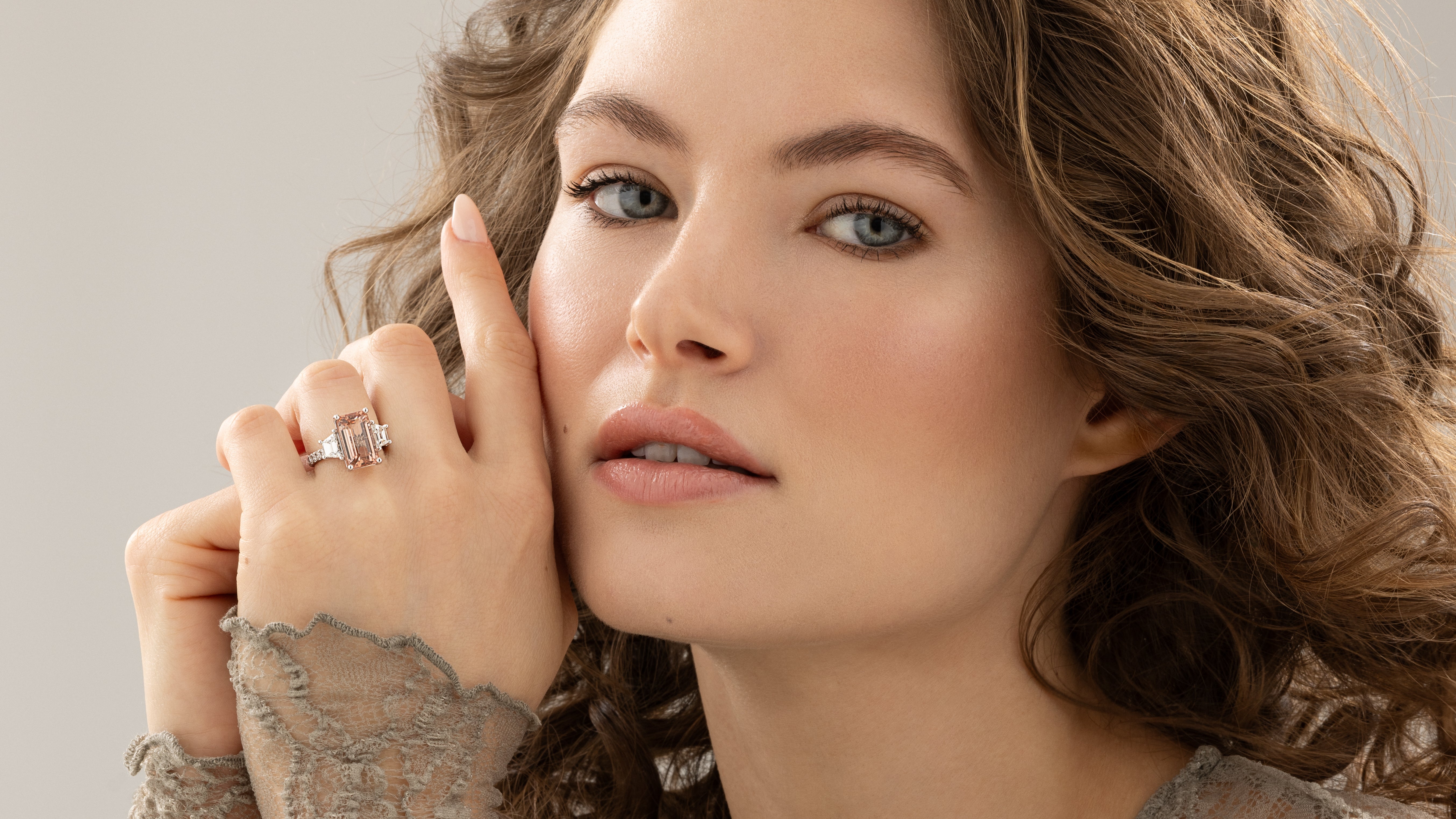
A three stone ring sets two side diamonds beside the centre, traditionally read as the past, the present and the future. It is the only one of the three that carries a built in meaning, which is why it appeals to couples who have already spent years together.
Visually it works differently from a halo. Instead of a bright frame it builds width along the finger, so the ring reads as substantial rather than sparkly, and two smaller side stones cost less than putting that weight into one larger centre. Tapered baguettes give a crisp art deco line, while round or pear side stones feel softer.
Explore three-stone rings →
Which setting suits your hands and your daily life?
Start with the finger, not the trend. Longer fingers carry wide three stone designs beautifully, shorter fingers look best with something that draws the eye lengthwise, and broader hands can take more scale without the ring looking heavy.
Then think about wear. A tall setting catches on gloves, pockets and hair, while a lower profile sits flatter and stays out of the way, and any ring with small pavé stones deserves a prong check roughly once a year. None of this rules a setting out, but it does decide how often the ring will be off the hand.
Explore engagement rings →
Which diamond shapes work best in each setting?
Round and oval remain the two shapes couples choose most, at 28 percent and 25 percent of rings, and they behave differently once a setting is around them. Rounds are the most forgiving and suit all three settings equally. Ovals are the flexible favourite: elegant alone, dramatic inside a halo that exaggerates their length, striking as a three stone centre.
Step cut shapes such as the emerald ask for restraint, because their long clean facets are the whole appeal and a busy frame fights them. A pear is the opposite: a shape with a point that a halo protects as well as flatters.
Explore oval cut rings →
How does each setting pair with a wedding band?
Most shoppers only ask this after the proposal, and it quietly decides how happy they are with the finished stack. A plain solitaire is the easiest partner, because a straight band sits flush against it. Halos and three stone rings often sit wider or lower, so a straight band can leave a visible gap beneath the centre stone.
There are two fixes, both better decided now than later. A contoured band is shaped to nest around the engagement ring, and a slightly higher setting profile lifts the centre stone so a straight band slides underneath. Say so while you are choosing, because planning a matching set costs nothing and retrofitting one costs patience.
Explore wedding rings →
Are halo rings dated, and are solitaires boring?
Neither is true, though both worries are common. The halo peaked in the 2010s and the busiest versions of that era do look of their time, but the style evolved rather than disappeared: today's halos sit closer to the stone, use finer metal work, and increasingly hide underneath it entirely.
Solitaires face the opposite accusation. A single stone looks plain only when the stone is small and the band is generic. A micro pavé band, a twisted shank or a chunkier modern profile turns a solitaire into a design without touching what makes it timeless. If you want to hedge, a hidden halo is the honest compromise: solitaire from above, halo from the side.
Compare every setting →
Frequently asked questions
Which engagement ring setting is the most popular?
The plain diamond solitaire, chosen for 32 percent of rings according to The Knot. Halo styles together account for a further 31 percent once hidden halos at 18 percent and classic halos at 13 percent are combined, so the split between clean and framed designs is closer than it looks.
Does a halo make a diamond look bigger than a solitaire?
Yes. A halo of small pavé diamonds around the centre stone typically adds the visual impression of roughly half a carat, and it does so for far less than buying that extra weight in the centre stone itself. The trade off is a busier design and more small stones to maintain.
Is a three stone ring more expensive than a solitaire?
Not necessarily. Two smaller side stones usually cost less than the same extra weight in one larger centre diamond, so a three stone design can deliver more width for a similar budget. On identical centre stones, though, the three stone costs more because it holds more diamonds.
Which setting is best for someone who works with their hands?
A low profile solitaire or a bezel style, where the metal wraps the girdle of the stone. Both keep the ring close to the finger with the fewest small stones to loosen. If a halo is the dream, choose a hidden halo, which keeps the top surface clean.
Can you change an engagement ring setting later?
Usually yes. A centre diamond can be reset into a new setting, and many couples do this for a milestone anniversary. It is skilled work rather than a simple swap, so treat it as a future option, not a reason to compromise today.
See all three settings side by side
Lab-grown diamond engagement rings in solitaire, halo and three stone designs.
Shop Engagement Rings →