

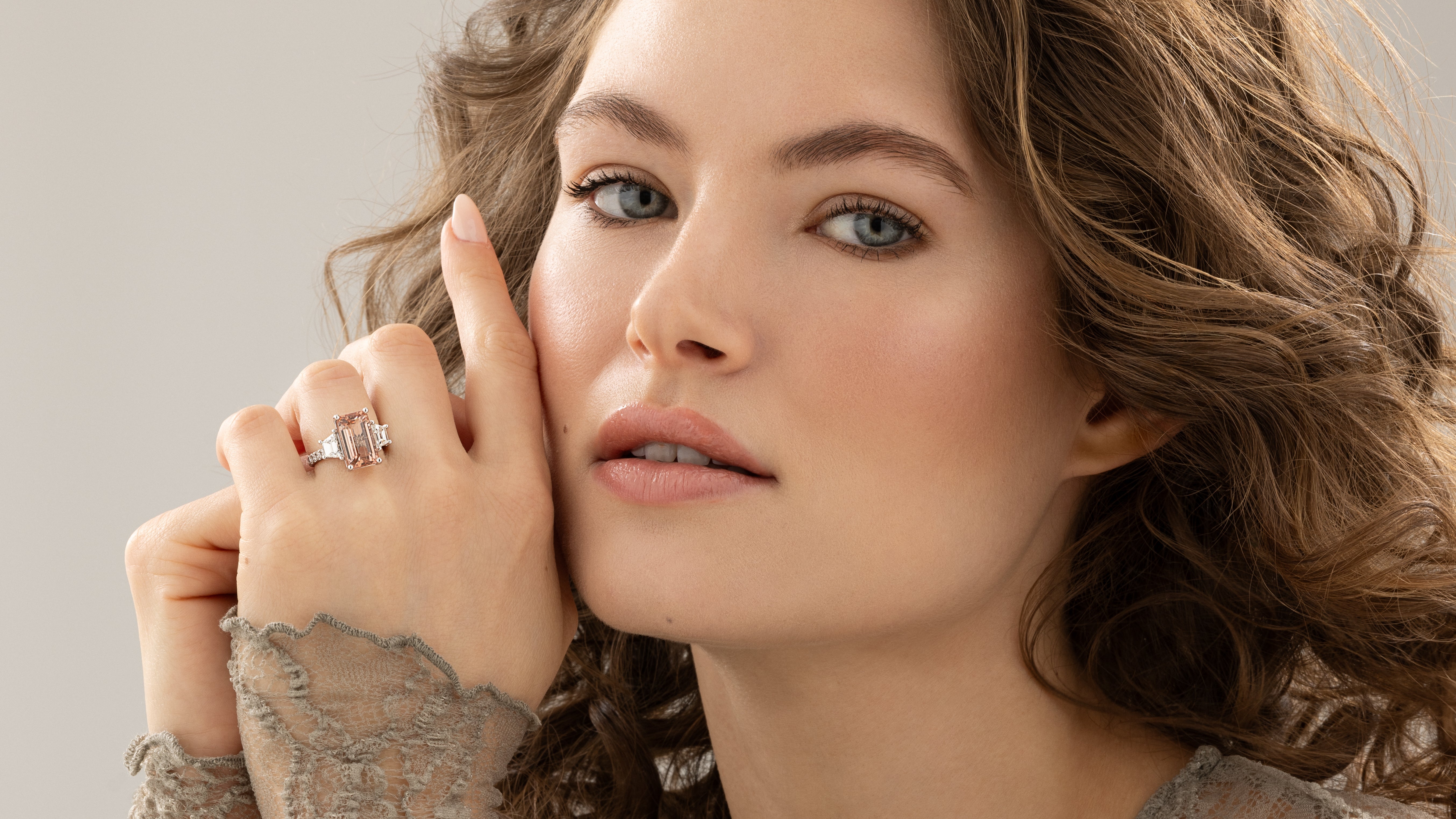

How to Choose a Wedding Band That Fits Your Engagement Ring
Choose a wedding band by checking how it fits beside your engagement ring before deciding how closely it should match. A straight band is a good first option when there is room beneath the centre setting. A curved or contoured band may suit a setting that projects into that space. A small gap is also a valid choice, provided the rings sit comfortably and a jeweller checks their contact points. The aim is a pairing you enjoy wearing together and a wedding ring you love on its own.

Will a straight wedding band sit flush?
Look at your engagement ring from the side. The basket is the structure holding the centre stone; the shank is the band around your finger. A wedding band needs room beside both. A centre stone that looks high from above does not, by itself, guarantee enough space underneath.
Try a simple straight band beside the ring without pushing them together. Check whether it rests naturally or catches against the basket, a hidden halo or the prongs. “Flush” describes a close fit without a visible gap, but it should never mean forcing the rings into position.
The GIA engagement ring buying guide recommends checking that stacked rings have compatible silhouettes and fit together. Start with that practical test, then decide which look feels like yours.

Straight, curved or contoured: which band should you try?
Use this table to build a shortlist. These are starting points for a fitting, not promises that a particular band will work with every ring of that type. A contour must suit the actual setting, not just the diamond shape.
| Band style | Worth trying when | What to check |
|---|---|---|
| Straight | The setting leaves space, or you like a gap | Basket clearance and comfort together |
| Soft curve | The centre setting projects beyond the shank | Curve depth and whether the band rotates |
| Defined contour or chevron | You want a shaped outline around the setting | Alignment, contact points and its appearance alone |
| Matching band | A companion design exists for the engagement ring | Compatibility with your exact setting and stone dimensions |
Does an oval or pear ring need a curved band?
Not automatically. Diamond shape influences the outline you see, while the setting determines the room available beside it. An oval in a raised setting and an oval in a low basket can need different wedding bands. The same principle applies to round, pear and emerald cut rings.
For an elongated centre stone, compare the band with the full length of the setting. A curve may frame it beautifully, but a straight line can offer a quieter contrast. With a halo or side stones, inspect the outermost details as well as the centre. Do not choose from the top-down photograph alone.
If you prefer a straight band, ask to see how a deliberate gap looks on your hand. A narrow space can make each ring easier to distinguish; whether you like that separation is a design preference.

Bring your engagement ring and compare the details with Labmond.
Should the wedding band match the engagement ring?
Choose one detail to repeat: metal colour, a smooth finish, a diamond shape or the character of the setting. You do not need to repeat everything. A restrained band lets an elaborate engagement ring lead, while a diamond band can give a simple solitaire more presence.
Compare the combined width on your finger rather than trying to match measurements exactly. Look with your hand relaxed and from a normal viewing distance. Then remove the engagement ring. If you expect to wear the wedding band alone often, its solo appearance deserves equal attention.
Matching metal colours creates continuity. Mixing colours is a personal styling choice, but ask the jeweller to assess the actual alloys and contact between the rings. Colour alone cannot tell you whether a pairing will wear well.

What should you check before choosing?
Bring the engagement ring to the fitting whenever possible. If you are starting virtually, prepare clear photographs from above and from both sides, plus any measurements you have. Photos help narrow the options; they cannot confirm comfort or every contact point.
Try the rings together, open and close your hand, and notice whether either ring tilts, pinches or presses into a neighbouring finger. Compare a smooth band and a diamond band if both appeal to you. Their edges and profiles can feel different even when their widths seem similar.
Ask the jeweller to check sizing with the complete pairing in place. Avoid ordering a different size simply because someone else sized up for a stack. Before committing, also confirm the chosen band’s resizing options, production timing and return terms, especially for a made-to-order piece.

Can the rings damage each other?
Contact deserves attention even when a pairing looks beautiful. GIA explains that diamonds can scratch the precious metals used in settings. Ask a jeweller to inspect whether exposed diamond edges or raised details rub against the neighbouring ring as the pieces move.
A small gap is not proof that every part stays separated. Equally, matching bands still need an assessment with your actual engagement ring. Have the jeweller explain where contact occurs and whether a different profile would be more suitable.
After purchase, arrange periodic checks appropriate to your settings and wear habits. If the rings begin catching, a stone feels loose or a contact point changes, have them inspected. Gentle care and a well-considered fit help preserve the details that drew you to the pairing.

Wedding band pairing FAQ
Is a gap between wedding and engagement rings bad?
No. A gap can be an intentional part of the look. Check comfort and contact with a jeweller, then choose the amount of visual separation you prefer.
Can I wear a curved wedding band alone?
Yes. Try it alone before buying to see whether you enjoy its shaped outline without the engagement ring. There is no requirement to wear the pair together every day.
Should both rings be the same width?
No. Similar widths can look coordinated, while different widths create contrast. Judge the combined proportions and comfort on your hand rather than following a fixed ratio.
Do lab-grown diamond rings need special matching bands?
Choose according to the setting, profile and fit. The fact that the centre diamond is lab-grown does not tell you whether a straight or curved band will sit beside it.
Make room for both rings
Explore Labmond engagement rings with your future wedding band in mind, or bring your existing ring to a conversation about the right pairing.
Shop Engagement Rings →