

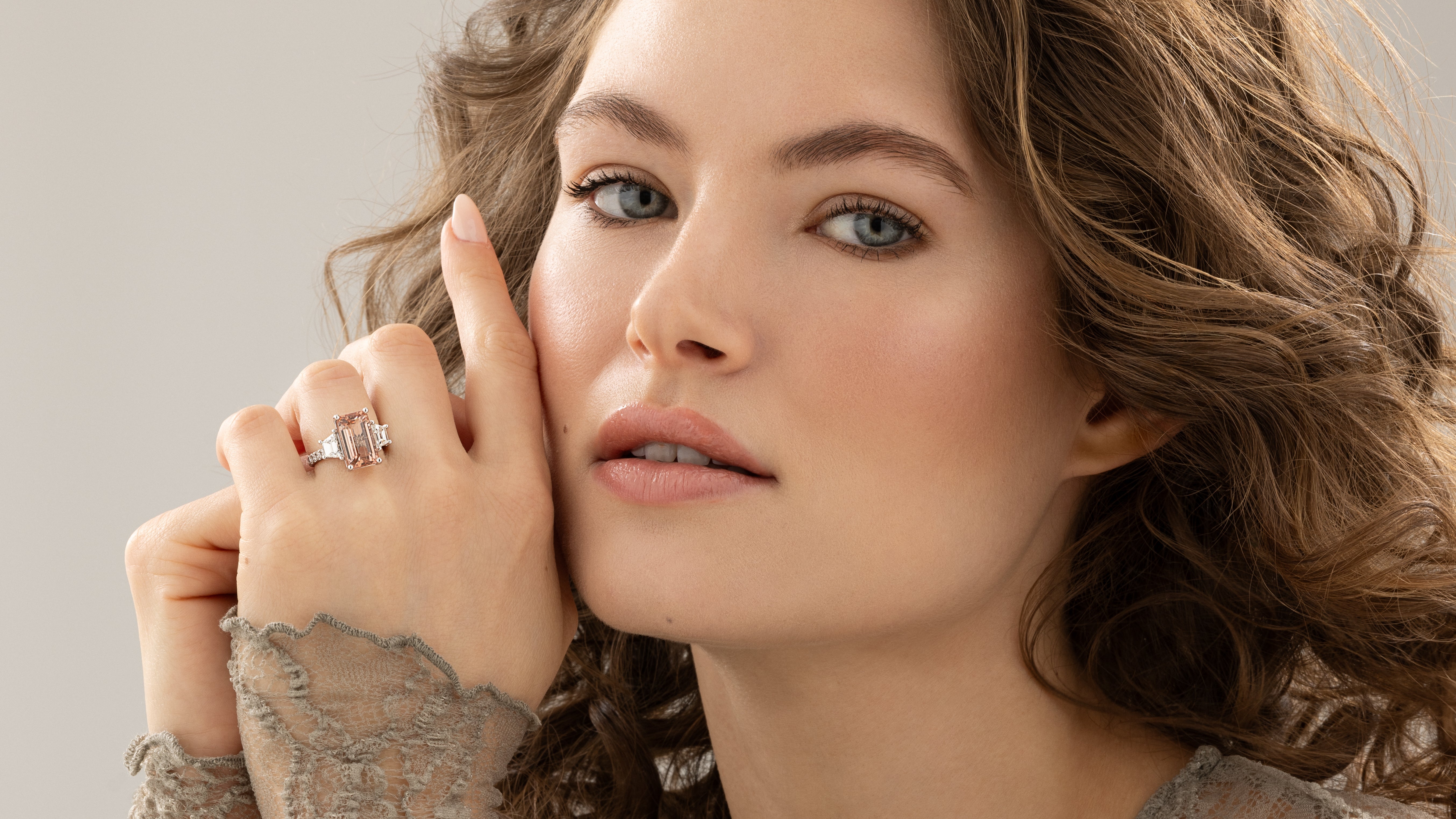

What Carat Size Should You Choose for a Lab-Grown Engagement Ring?
Most people choosing a lab-grown diamond engagement ring land between 1.5 and 2.5 carats, and there is a practical reason for that. Because lab-grown stones cost a fraction of mined equivalents, the old budget ceiling that pushed shoppers toward 1 carat has largely lifted, so the question is no longer what you can afford but what actually suits the hand. The honest answer: pick the carat weight that fills the space between your knuckles without overhanging the finger, then let shape and setting do the rest. A 1.5 carat oval covers noticeably more finger than a 1.5 carat round, and a hidden halo can make either read half a carat larger. Below is how each weight really looks in millimetres, how shape changes the maths, and where extra carats stop being worth it.

What Carat Size Should You Choose for an Engagement Ring?
Start between 1.5 and 2 carats and adjust from there. That range is large enough to read as a serious centre stone on almost any hand, small enough to sit comfortably under gloves and gym equipment, and it tracks where the market has actually landed. Jewellery insurer BriteCo, which appraises rings rather than sells them, puts the median engagement ring centre stone at 2.0 carats in 2025, up from just 1.01 carats in 2019.
Go up toward 2.5 carats if the wearer has longer fingers, wears statement jewellery, or simply wants presence. Stay nearer 1 to 1.25 carats if they have petite hands, work with them all day, or prefer a quiet ring. Carat weight is a preference, not a scoreboard.

How Big Does Each Carat Weight Actually Look?
As the Gemological Institute of America puts it, carat measures weight, not size. So the only honest way to picture a stone is in millimetres. Here is roughly what each weight measures face up across four popular shapes. Hold a ruler against these numbers: it beats any photograph.
| Carat weight | Round | Oval | Emerald | Pear |
|---|---|---|---|---|
| 1.00 ct | 6.5 mm | 8.3 by 5.6 mm | 7.2 by 4.9 mm | 9.1 by 5.5 mm |
| 1.50 ct | 7.4 mm | 9.5 by 6.4 mm | 8.2 by 5.7 mm | 10.5 by 6.3 mm |
| 2.00 ct | 8.1 mm | 10.5 by 7.1 mm | 9.0 by 6.2 mm | 11.5 by 7.0 mm |
| 3.00 ct | 9.3 mm | 12.0 by 8.1 mm | 10.4 by 7.1 mm | 13.2 by 8.0 mm |
Typical face up dimensions for well proportioned stones at standard length to width ratios. Individual stones vary, so always check the measurements printed on the grading report.
Notice how little a round grows between weights. Doubling from 1 to 2 carats adds only about 1.6 mm of diameter, because weight rises with volume while width rises far more slowly. This is the single most useful thing to know before you buy: the jump from 1 to 1.5 carats is very visible, and the jump from 2.5 to 3 carats is not.
Does Shape Change How Large a Carat Looks?
Considerably. Elongated shapes carry more of their weight across the top of the stone and stretch along the finger, so they read larger than a round of identical weight. A 1.5 carat oval measures about 9.5 mm long against a round's 7.4 mm, and the eye reads length as size.
Pear and emerald cuts do the same thing with different personalities: pear is the longest of the four at any given weight, while emerald trades sparkle for a clean, architectural spread. If maximum visual size per carat is the goal, an elongated shape gets you there before extra weight does.

Does Finger Size Change the Carat You Need?
Yes, and it is the factor most guides ignore. The same stone looks meaningfully different on a size 4 finger than on a size 8. On slimmer fingers a 1 carat centre already looks generous and a 2.5 carat one can overhang the edges. On longer or broader fingers, a 1 carat stone can disappear and 2 carats reads as balanced.
A simple rule that holds up well: the centre stone should sit within the width of the finger, with a sliver of skin visible on either side. If it reaches the edges, it will catch on clothing and feel heavier than it is. If you are unsure, try on two weights either side of your guess before committing.

Compare carat weights side by side with a specialist, online or in person.
Should You Trade Cut Quality for a Bigger Stone?
No. Cut is the one grade that changes how a diamond behaves in daylight, and a poorly cut 2 carat stone will look duller than a beautifully cut 1.5 carat one. Weight you can see; light return you can feel across a room. When a budget forces a choice, hold the cut grade and let the carat weight give.
Colour and clarity are where the real savings hide. Most inclusions in the middle clarity grades are invisible without magnification, and a faint warmth in colour disappears entirely once a stone is set in yellow or rose gold. Spend there strategically, and put what you save into the weight and the cut.

How Do You Make a Diamond Look Bigger Without Adding Carats?
Four settings choices do most of the work. A halo of small diamonds adds visible diameter around the centre stone and can make a 1 carat centre read closer to 1.5. A hidden halo does the same job from the side, lifting the stone and adding sparkle without changing the outline from above.
Then there is contrast. A thin, delicate band makes any centre stone look larger simply because there is less metal competing with it, and a slim prong or claw setting exposes more of the diamond's outline than a heavy bezel. Combine an elongated shape, a thin band and a hidden halo, and you gain the visual effect of roughly half a carat without paying for it.

Why Are Lab-Grown Centre Stones Getting Larger?
Because the price barrier moved. Lab-grown diamonds are chemically and optically identical to mined stones, and they cost dramatically less, so the budget that once bought a 1 carat centre now reaches well past 2. That shift is why lab-grown stones appeared in 51 percent of newly appraised engagement rings in the first half of 2026, according to BriteCo's jewellery and diamond price index, up from under 6 percent in 2019.
The useful consequence is freedom. You can choose the weight that flatters the hand rather than the weight the budget dictates, and put the difference into a better cut, a stronger setting, or a matching band. Size stops being the compromise it used to be.

Frequently Asked Questions
Is a 2 carat lab-grown diamond too big for everyday wear?
For most hands, no. A 2 carat round measures about 8.1 mm across, which sits comfortably within an average finger width. What makes a ring impractical is height rather than weight, so if the wearer is hands on all day, ask for a lower profile setting rather than dropping carats.
Does a 1.5 carat diamond look much bigger than a 1 carat?
Yes, and this is the most worthwhile step up on the scale. A round grows from roughly 6.5 mm to 7.4 mm, an increase of about 14 percent in diameter, which is clearly visible on the hand. By contrast, the step from 2.5 to 3 carats is far harder to notice.
What carat size looks best on small fingers?
Between 1 and 1.75 carats suits most petite hands, and an elongated shape such as oval or pear will look larger than its weight while keeping the finger looking long. A very wide stone on a small finger tends to overhang the edges and catch on clothing.
Can you tell a lab-grown diamond is lab-grown by its size?
No. Lab-grown diamonds have the same crystal structure, hardness and optical behaviour as mined diamonds, so a 2 carat lab-grown stone looks identical to a 2 carat mined stone. Only specialist laboratory equipment can tell the two apart.
Should you go bigger just because lab-grown diamonds cost less?
Only if the larger stone genuinely suits the hand. The lower price is best spent on the combination of a strong cut grade, a shape you love and a setting built to last, with carat weight chosen for proportion rather than for the number on the certificate.
See the Carat Weights on Your Own Hand
Try 1, 1.5 and 2 carat lab-grown diamonds in every shape and gold colour, with no pressure and no obligation.
Shop Engagement Rings →