

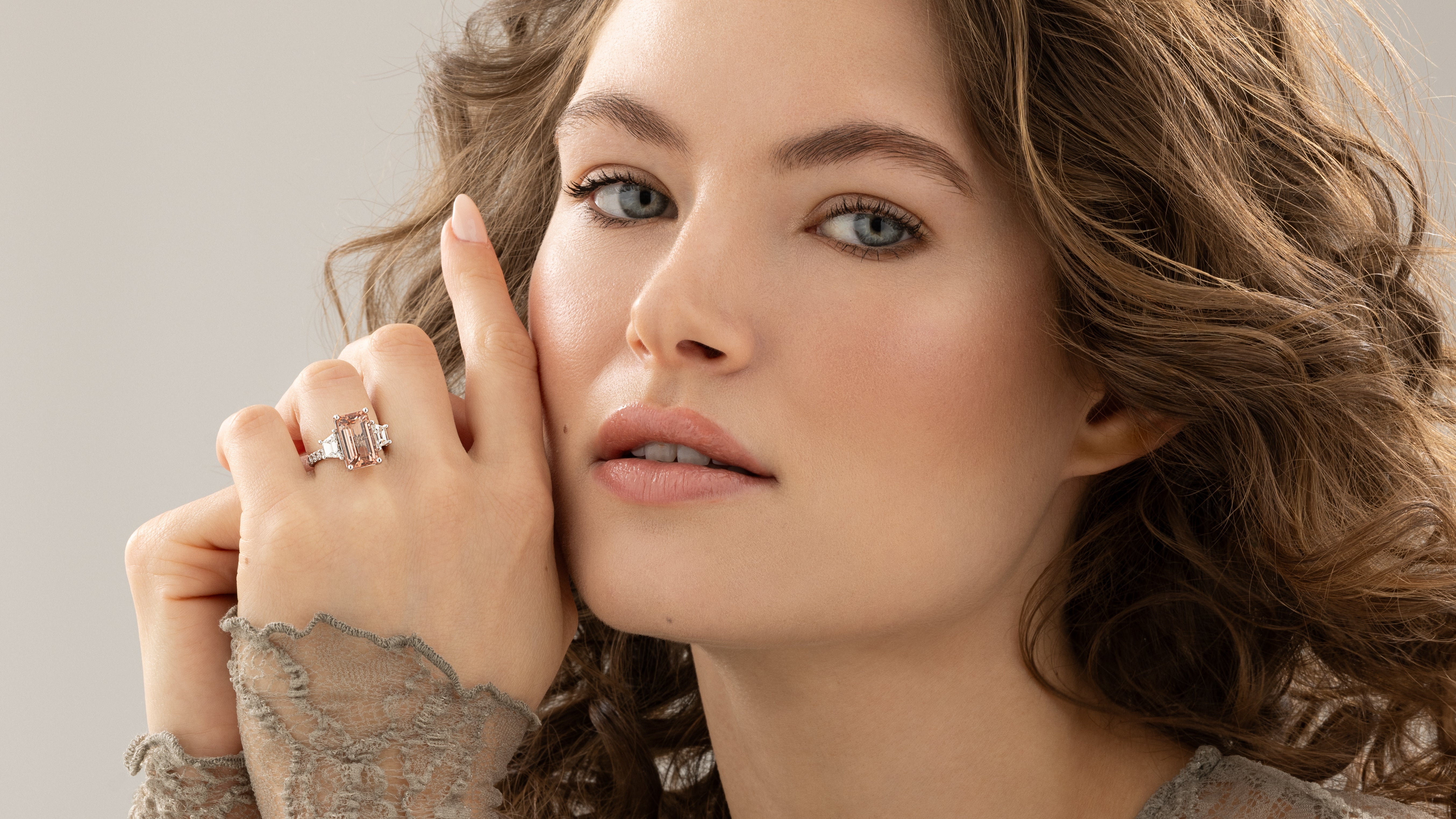

Plain or Pavé: Which Engagement Ring Band Should You Choose?
Choose a plain engagement-ring band if you prefer uninterrupted metal around the centre stone. Choose pavé if the small diamonds along the band are part of what makes the ring feel right to you. Then compare the actual construction, fit and service requirements before deciding. A plain band is not automatically indestructible, and pavé does not automatically mean uncomfortable. For a lab-grown diamond engagement ring, the useful question is where you want the detail: concentrated at the centre, carried along the band, or shared with a future wedding ring. Try both approaches on your hand, away from an enlarged product photograph.

START WITH THE DETAILS
What is the difference between plain and pavé?
A plain band has no accent stones along the part that circles your finger. It can still have a distinctive outline, tapered shoulders or a particular surface finish. Plain describes the absence of those stones, not a lack of design. Look at the metal from above and from the side before deciding whether it feels understated or substantial.
Pavé describes closely placed small gemstones, commonly held with tiny metal beads or prongs, as explained in GIA’s guide to ring settings. Ask which surfaces carry stones: the top, the sides, or both. A product name alone may not make that clear. A hidden detail beneath the centre stone is a separate choice from diamonds along the band.
When comparing photographs, check that you are looking at the same view. A top view can conceal side-set details, while a dramatic angle can make a narrow band look much wider. Request both views of each candidate.

FOLLOW YOUR EYE
Which look do you prefer on your hand?
Start with the centre stone you want to notice, then consider the surrounding detail. With a plain band, the visible metal creates a quieter frame. With pavé, your eye can follow a line of small stones towards the centre. Neither treatment changes the centre diamond’s actual dimensions.
Compare similar centre shapes and metal colours where possible. Otherwise, you may be responding to the oval rather than the band, or to yellow gold rather than the amount of detail. The illustrations here show different designs; they are examples of band treatments, not a controlled size comparison.
Look at your whole hand at a normal viewing distance. Then look closely. If you love the pavé only in a highly enlarged image, ask whether enough of that detail is visible when you wear it. If plain metal feels too quiet by itself, try the ring with a wedding band before ruling it out.

THINK ABOUT THE FIT
What should you check while trying it on?
Try the correct size, or ask the jeweller how the sample differs from the intended fit. Relax your fingers, bend your hand and notice the contact with adjacent fingers. Describe any roughness or pressure precisely. Do not assume it is normal for a diamond-set band to feel uncomfortable.
Ask to see where the small stones stop. Compare a design with detail mainly across the visible shoulders with one that continues farther around the finger. Your preference may depend on what touches your neighbouring fingers as much as what you see from above.
Consider the full ring rather than the band in isolation. The centre setting’s height and shape can affect how the piece feels. Our setting-height guide helps you separate that decision from the choice of band detail.
MAKE THE COMPARISON FAIR
A checklist for the two rings
Use this checklist during an appointment. Record the answers for each actual ring instead of treating a style label as a specification. If a sample is not the final design, ask which details will change.
| Compare | Ask about each ring |
|---|---|
| Appearance | Which details are visible at a normal distance? |
| Surfaces | Are stones set on the top, sides or both? |
| Comfort | Where does the band touch neighbouring fingers? |
| Resizing | What changes are feasible for this design? |
| Care | What needs checking and which services are included? |
PLAN FOR LATER
Can a pavé engagement ring be resized?
GIA notes that resizing a pavé band can be more difficult because adjustments may disturb the small stones. That is a reason to ask about the specific design, not a reason to assume every pavé ring is impossible to resize.
Ask what size changes the jeweller considers feasible, whether the stones extend into the area that would be altered, and whether the ring would need to be remade instead. Get the answer before ordering. A plain section at the bottom is useful information to discuss, but it is not a guarantee of unrestricted resizing.
If the ring is a surprise, tell the jeweller how certain you are about the size. Confirm the applicable exchange, alteration and remake terms in writing. Avoid choosing a setting on the assumption that any sizing problem can be resolved later without affecting its design.
UNDERSTAND THE UPKEEP
What care does the band need?
A plain band removes the question of maintaining accent stones along the shank, but the centre stone and its setting still deserve attention. With pavé, ask the jeweller to explain how the small settings will be checked, what signs should prompt a visit and which services are included.
For cleaning, follow advice for the complete ring, including any other gemstones. GIA’s diamond care guide cautions against home ultrasonic and steam cleaning because stones can loosen. Ask for a suitable home routine rather than choosing a device on the assumption that diamonds cannot be damaged.
Keep service records with your purchase documents. If something catches, feels different or appears missing, stop wearing the ring and arrange an inspection. Do not try to tighten a small setting yourself. Ask about repair procedures and possible replacement-stone matching before these become urgent questions.
SEE THE WHOLE SET
Where do you want the extra detail?
Try a plain engagement ring with a diamond-set wedding band, then reverse the arrangement. You may discover that you want the engagement ring to be quiet and the wedding band to carry the detail, or that you love the pavé engagement ring worn alone.
Inspect the contact between the two rings, not just their appearance from above. Ask the jeweller to assess where metal or stones touch. Matching visual styles do not guarantee a suitable physical fit. Our wedding-band pairing guide explores that decision separately.
Before ordering, write down your preference in one sentence. Perhaps you like a visible line of gold, or you enjoy diamonds continuing along the shoulders. That reason is more useful than choosing whichever style is described as the most timeless.

YOUR QUESTIONS
Plain and pavé band FAQ
Does pavé make the centre diamond bigger?
It adds detail around the centre, but it does not change the centre stone’s dimensions. Compare the actual ring on your hand rather than judging size from the total sparkle in a photograph.
Is a plain band maintenance-free?
No. Ask about the centre setting, the metal finish and the recommended inspections. Fewer accent stones do not remove the need to care for the complete ring.
Do I have to match a pavé ring with a pavé wedding band?
No. Try several combinations and choose the balance you enjoy. Have the jeweller check the physical contact between the rings as well as the appearance.
What should I ask before ordering online?
Request top and side views, band dimensions, stone placement, sizing options and written care and alteration terms. Confirm whether the images show the exact ring or an illustrative sample.
YOUR NEXT STEP
Find your favourite details
Explore Labmond’s engagement rings and bring two favourites to your appointment. Compare the visible metal, the small stones and the fit, then choose the band you enjoy as part of the whole ring.
Shop Engagement Rings →